
Inflation for Beginners
A Guide to Inflation
Inflation has been a popular topic in today's news recently. It's important during times like these that you understand exactly what inflation is and why you may see prices rise.
What is Inflation?
Inflation is an economic term that describes a general increase in prices and a fall in the purchasing power of money. A little bit of inflation is normal and even good for a healthy economy. Inflation becomes a problem when it grows too quickly. Money losing value at a rapid rate can lead an entire economy to spiral out of control. All governments and central banks try to control inflation with regulation and monetary policy. Inflation is expressed as a percentage.
Example - Rise in Prices:
-
In 1950, you could buy a cup of coffee for $0.22 while today an average cup of coffee is $3.59.
Example - Falling Purchasing Power of Money:
-
In 1950, you could buy a cup of coffee for $0.22 while today an average cup of coffee is $3.59.
Inflation = Rise in costs of goods and services.
Inflation Rate = Percent increase or decrease in prices over time.
What Causes Inflation?
In simpler terms, inflation occurs when there’s an increase in production costs OR when demand for products and services increases faster than supply. Inflation can come about in many different ways. All these causes are most commonly classified into three main types of inflation.
Three Main Types of Inflation
1. Cost-Push Inflation
- Prices increase when the cost of production increases. If it costs more to make a product or provide a service the companies will pass that cost on to consumers by increasing the price of those products and services. Here are some things that can cause cost-push inflation.
- Examples: Increase in prices of raw materials
- If the price of oil rises, all industries that rely on oil will increase their prices to offset that rise in cost.
- Examples: Increase in prices of raw materials
2. Demand-Pull Inflation
-
Prices increase when demand increases faster than production. If everybody wants to buy something that is in limited supply they will be willing to pay more money for it and the companies will charge more for the same product or service. Here are some things that can cause demand-pull inflation:
-
Growing Economy - When things are going well, people have jobs and they are confident that the good times will last they tend to spend more money and create demand.
-
Increase in the Money Supply - When the government invests in infrastructure or hires people money gets injected into the economy causing prices to rise.
-
3. Built-in-Inflation (Wage-Price-Spiral)
-
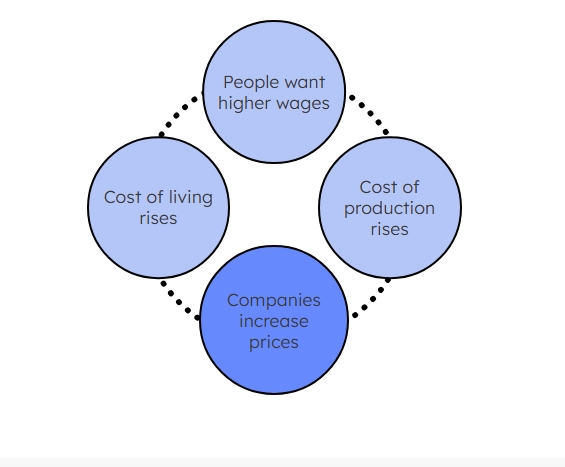
Workers want higher wages to keep up with the cost of living. When prices rise due to cost-push or demand-pull inflation people expect higher wages so they can keep their lifestyle and standard of living. Higher wages make companies increase the price of their goods and services. This raises the cost of living and makes workers demand higher wages.
Increase in the Money Supply and Inflation
Most people will correlate governments printing money with inflation. An increase in the overall money supply can sometimes lead to both cost-push and demand-pull inflation. Money supply creates inflation only when the money is printed faster than the economy grows. Keep in mind that the money supply is not just hard cash, but also credit, loans, and mortgages.
-
Monetary Policy – When central banks lower interest rates it’s cheaper for banks to lend money. Banks will then lend more money to businesses and individuals who will spend it. More money being spent increases demand, which increases prices.
-
Fiscal Policy – If the government cuts taxes, makes stimulus payments, or increases benefits, people have more money to spend. If business taxes are cut, businesses can increase wages or hire more people. People have more money, they spend more, demand increases, which increases prices.
-
Exchange Rates – When there’s more money in circulation, the currency loses value in relation to foreign currencies. This makes imported products more expensive because now your currency has less purchasing power. The governments can also choose to lower the exchange rates to make local products more competitive. This will also lead to imports being more expensive.
☝️ It might be worth pointing out that increasing the money supply only increases demand if the extra money ends up in the hands of customers.
👉 For example, in the wake of the 2008 recession, interest rates were very low, but loan criteria were very tight. This meant that the cheap money flowed mainly to the rich. As a consequence, we saw rapid inflation in asset prices (rich people buy stocks and real estate) and much less inflation in consumer goods.
Who Benefits and Who Gets Hurt by Inflation
Inflation does not impact everyone the same. Some people get hurt by the fall in the value of currency, while others can benefit from it.
Winners
- Debtors
- Especially if their debts carry fixed rates. They pay their loans back in less valuable currency.
- Owners of land and physical assets
- These assets tend to hold their value through inflationary periods.
- Break-Even
- Workers whose salaries are indexed to inflation will not be adversely affected by inflation.
Losers
- Savers
- If the inflation rate is higher than the interest rate, savings are decreasing in value.
- Retirees on fixed incomes
- If you have a fixed pension or interest income from investments, your income will not grow with inflation.
- Workers on fixed-wage contracts
- If your wage doesn't rise with inflation, it is effectively getting smaller.
- Borrowers with variable-rate loans
- Governments often raise interest rates to try to make their currency more desirable. That can push interest rates on variable-rate loans up.
- Lenders of fixed-rate loans
- If you are lent money at a fixed rate, you are getting paid back in less valuable currency.
How is Inflation Measured?
To measure inflation, we need to use a device called an inflation index. There are multiple ways to measure inflation and that’s why several inflation indexes exist. It’s impossible to keep track of price changes for every single product or service in the economy. That’s why inflation indexes follow price changes of only a small number of goods and services.
Consumer Price Index (CPI)
The most well-known inflation index is the Consumer Price Index (CPI). CPI examines the average price of a hypothetical basket of goods and services in order to see if there are any changes in the overall cost of living. Different items in the basket carry different weights. These weights reflect the varying importance of items in the consumer’s shopping basket (having a roof over your head carries more weight than having a gym membership). The increase or decrease in prices of all the items when expressed as a percentage represents the inflation rate.